Wedge Chart Patterns
Wedges signal a pause in the current trend. When you encounter this formation, it signals that forex traders are still deciding where to take the pair next. Wedges could serve as either continuation or reversal patterns.
Rising Wedge
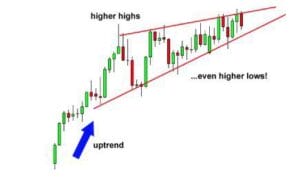
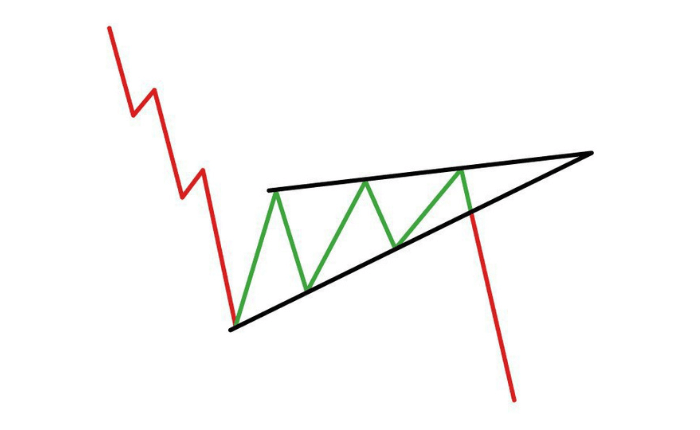
A rising wedge is formed when the price consolidates between upward-sloping support and resistance lines. Here, the support line’s slope is steeper than the resistance’s. This indicates that higher lows are being formed faster than higher highs. This leads to a wedge-like formation, precisely where the chart pattern comes from! With prices consolidating, we know a big splash is coming, so we can expect a breakout to the top or bottom. If the rising wedge forms after an uptrend, it’s usually a bearish reversal pattern. On the other hand, if it forms during a downtrend, it could signal a continuation of the downmove.
Falling Wedge
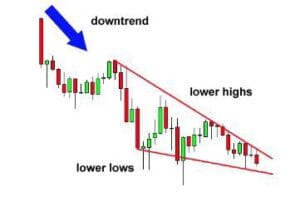
Like the rising wedge, the falling wedge can be a reversal or continuation signal. As a reversal signal, it is formed at the bottom of a downtrend, indicating that an uptrend would come next. As a continuation signal, it is formed during an uptrend, implying that the upward price action would resume. Unlike the rising wedge, the falling wedge is a bullish chart pattern. In this example, the falling wedge serves as a reversal signal. After a downtrend, the price made lower highs and lower lows.